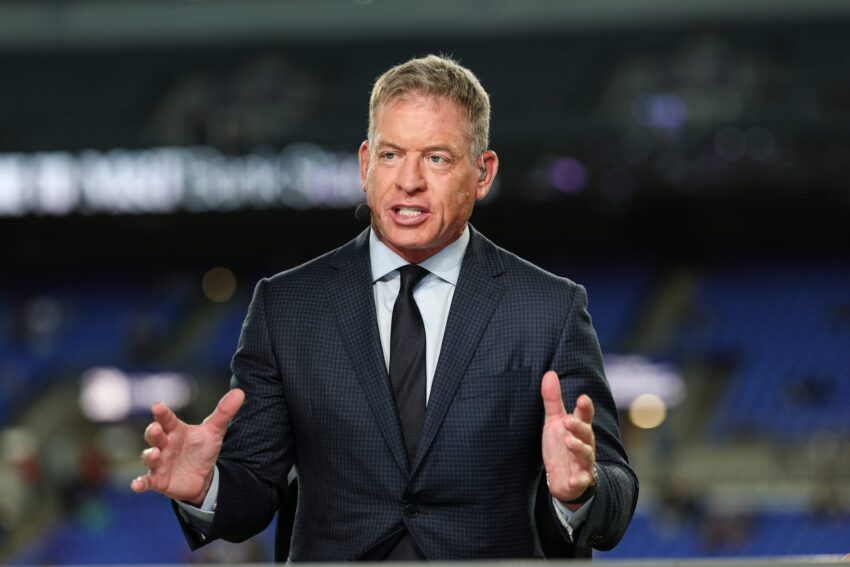

Buffalo, NY – April 24, 2026
The first night of the 2026 NFL Draft was supposed to be about prospects, team-building, and the future of franchises across the league.
But shortly after Day 1 wrapped up, an unexpected controversy erupted — and the center of it was not a rookie, a general manager, or a blockbuster trade.
It was Troy Aikman.
During ESPN’s post-Draft coverage, Aikman delivered sharp criticism of Buffalo Bills head coach Joe Brady and the team’s approach after the opening night of selections.
At first, the comments sounded like standard draft analysis.
But as the segment continued, Aikman’s tone shifted.
He suggested that Brady’s decisions were not being guided purely by roster value or long-term team needs, but by personal preference and a desire to force players into his own system.
The phrase “personal preference over team value” quickly became the center of the backlash.
For a Bills team entering a critical draft cycle, the remark was viewed by many fans as more than just analysis.
It sounded like a direct attack on Brady’s credibility.
Buffalo had just completed the first night of the draft, a moment meant to define the next stage of the franchise’s rebuild. Instead, the conversation immediately turned toward whether one of the NFL’s most recognizable analysts had crossed the line.
Fan reaction was immediate.
Across social media, Bills supporters accused Aikman of disrespecting a head coach still working to establish his identity in Buffalo. Others argued that criticizing a draft pick is fair — but questioning a coach’s motives is something different entirely.
Within hours, pressure began building on ESPN.
By the next morning, the network had made its decision.
ESPN President James Pitaro approved the suspension of Troy Aikman from NFL-related programming, a move seen as an attempt to prevent the controversy from overshadowing the remaining days of the Draft.
According to internal reaction surrounding the decision, ESPN believed the remarks had moved beyond normal football debate.
“We cannot allow comments driven by personal tone to overshadow an event as important as the NFL Draft,” one message reportedly reflected.
The timing made everything more serious.
After Day 1 of the Draft, every word carries extra weight. Teams are still making decisions. Players are waiting to hear their names called. Coaches and front offices are trying to control the direction of their franchises.
For Buffalo, the controversy arrived at the worst possible moment.
Inside the Bills organization, the reaction was reportedly frustration. Brady, already facing pressure to guide the team into a new era, received strong support from within the locker room.
Several analysts also pushed back against Aikman’s remarks, arguing that questioning a coach’s football philosophy is one thing — but implying personal bias in draft decisions crosses a professional boundary.
Aikman’s status as a Hall of Fame quarterback only made the situation bigger.
His words carry influence. His opinions shape national conversation. And in the middle of the NFL Draft, that influence becomes even stronger.
That is why ESPN’s response was so swift.
This was not simply about one comment.
It was about the line between honest analysis and personal accusation.
The 2026 NFL Draft still had multiple rounds left to unfold, but after just one night, the biggest story was no longer only about who Buffalo selected.
It was about what was said afterward.
And in today’s NFL, sometimes words can hit just as hard as any decision made on draft night.
The Los Angeles Dodgers moved the entire MLB when they announced a commitment to provide financial support and lifetime health insurance for Andrew Toles in his battle with mental health.
However, what truly made this story explode was Toles himself, when he unexpectedly refused the entire $3 million support package and instead donated the money to charities in Los Angeles.
“I’ve received so much already. The love of the fans is the most effective medicine I’ve ever received,” Toles shared in a short but emotional message, enough to leave the baseball community speechless.
Andrew Toles isn’t a superstar, but he was a crucial part of the Dodgers’ 2020 World Series victory, a player who played with dedication and fighting spirit, before having to leave the field due to serious mental health issues.
For years, the Dodgers quietly kept him on their roster to ensure he had health insurance, a rare act that showed they considered him family, not just a name on the roster.
When the team decided to increase their support to millions of dollars, many believed it was a beautiful ending to a heartwarming story, but Toles chose to continue in an unexpected way.
He didn’t accept the money, not out of pride or a refusal of help, but because he wanted to make it more meaningful for the community.
Los Angeles is not only where he played basketball, but also where he felt the empathy and love from fans most strongly during the most difficult period of his life.
Therefore, donating this money to charity is not just a personal decision, but also a way for him to give back what he has received.
In a world of sports where multi-million dollar contracts are often the center of attention, Toles’ actions offer a completely different perspective, where value lies not in numbers but in how people treat each other.
He’s no longer on the court, no longer making runs or hitting shots, but his influence now is perhaps greater than at any other point in his career.
The reaction from Dodgers fans and the entire MLB was almost instantaneous, social media overflowing with praise, respect, and heartfelt messages.
Many recalled the image of a humble player who always played with heart, and who still retains that quality even after leaving the spotlight. For them, Toles is not just a former player, but a symbol of gratitude and resilience.
The Dodgers didn’t try to change his mind, because they understood that Toles’ journey was a very personal one, a journey where the most important thing wasn’t money, but healing.
What they did was open a door, and Toles chose to walk through that door in a way that would bring value to more people.
This story also raises a big question for MLB and sports in general: Is success truly measured only by titles and contracts?
For Andrew Toles, the answer seems clear, because he doesn’t need to return to the court to create a legacy; he’s doing it through the way he lives and the choices he makes.
“I’m still healing, and every word of encouragement from the fans helps me move forward,” he said, a simple statement that perfectly reflects what he values.
In a world full of pressure and expectations, sometimes it’s the connection between people that keeps us going.
Andrew Toles may no longer be playing, but his story is spreading more powerfully than ever, not because of its drama, but because of its authenticity.
The Dodgers sent a message about responsibility and humanity, and Toles responded with an action that made everyone reflect: sometimes the greatest value lies not in what you receive, but in how you choose to give.