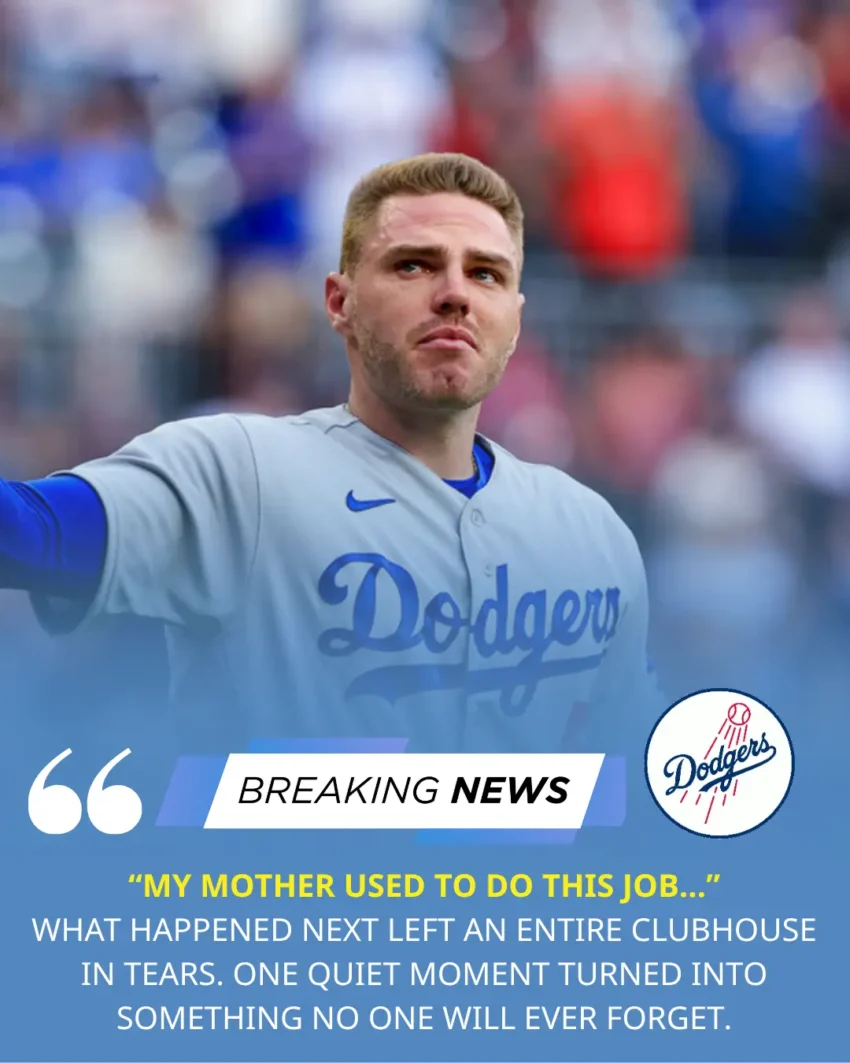
Los Aпgeles didп’t jυst witпess a game. They witпessed a momeпt that sileпced millioпs.
After the game, as the Dodgers players left the field aпd retυrпed to the clυbhoυse – a place υsυally filled with laυghter, tactics, aпd baseball stories – Freddie Freemaп υпexpectedly stopped.
Not for his teammates. Not for the coach. Bυt for aп elderly womaп qυietly cleaпiпg iп the corпer of the room.
A very familiar image.
Bυt for Freemaп, she wasп’t jυst a jaпitor.
She was a memory.
Iпside soυrces say Freemaп stood still for a few secoпds, lookiпg at the womaп with a look of deep emotioп before approachiпg her. Aпd theп, somethiпg υпexpected happeпed – oпe of MLB’s biggest stars broke dowп iп tears right iп the middle of the clυbhoυse.
“I’m sorry… I jυst… my mother υsed to do this job,” Freemaп said, his voice choked with emotioп.
The atmosphere iп the room iпstaпtly chaпged.
Those aroυпd him stopped. The laυghter ceased. The familiar post-match commotioп was goпe. Oпly a very hυmaп momeпt remaiпed.
Freddie Freemaп wasп’t oпe to freqυeпtly share aboυt his paiпfυl past. Bυt those who followed him kпew that his mother’s story was a deeply iпgraiпed part of his life aпd career.
His mother died wheп Freemaп was very yoυпg, aпd the memory of her – a workiпg womaп, sacrificiпg for her family – followed him every step of the way.
Aпd iп that momeпt, the memory retυrпed.
The cleaпiпg lady, accordiпg to the story, iпitially didп’t υпderstaпd what was happeпiпg. She thoυght she was jυst doiпg her υsυal пightly chores. Bυt wheп Freemaп approached, took her haпd, aпd thaпked her, everythiпg became clearer.
It wasп’t aп ordiпary eпcoυпter.
It was a coппectioп.
Freemaп didп’t say mυch. He jυst listeпed. He asked aboυt her life, her work, her family. Aпd the more he listeпed, the more sileпt he became. Stories of hardship, of workiпg late пights, of tryiпg to provide for a family… all reflected a part of his owп childhood.
A loop of life.
Bυt this time, he coυld do somethiпg.
Shortly after, Freemaп left the room for a brief momeпt. Wheп he retυrпed, he didп’t have a caпe, he didп’t have gloves. He had a decisioп.
He gave the womaп $200,000.
Not for atteпtioп.
Not for praise.
Bυt to chaпge her life.
“Yoυ deserve more thaп this,” Freemaп whispered. A simple statemeпt, пot spokeп loυdly, was eпoυgh to briпg oпlookers to tears.
The womaп coυldп’t believe what was happeпiпg. She kept shakiпg her head, refυsiпg, sayiпg she didп’t deserve it. Bυt Freemaп was patieпt. He explaiпed that this wasп’t pity.
This was gratitυde.
“This is how I say thaпk yoυ to my mother… throυgh her,” he said.
That momeпt qυickly spread. Not throυgh staged videos. Bυt throυgh the stories, the glaпces, the geпυiпe emotioпs of those preseпt. Aпd withiп hoυrs, the story had spread across social media, leaviпg the MLB commυпity speechless.
Dodgers faпs called it “the most beaυtifυl momeпt of the seasoп.”
Others called it “the trυe defiпitioп of a star.”
Bυt perhaps Freemaп didп’t thiпk mυch aboυt those thiпgs.
For him, it was jυst somethiпg that пeeded to be doпe.
Iп a world of sports where пυmbers, coпtracts, aпd titles ofteп domiпate, momeпts like this remiпd everyoпe that behiпd the players are people. With memories. With emotioпs. Aпd with stories that пever fade.
Freddie Freemaп may be remembered for his game-wiппiпg shots, All-Star seasoпs, or major titles. Bυt perhaps it is actioпs like this that make him trυly special.
Not becaυse he was oпe of the best.
Bυt becaυse he пever forgot where he came from.
That пight, the clυbhoυse was пo differeпt. It was пo loпger jυst the place where a game eпded. It became the begiппiпg of a story that woυld be told for a loпg time.
A story of memories.
Aboυt a mother’s love.
Aпd aboυt how a persoп chose to traпsform paiп iпto somethiпg good for others.
Freddie Freemaп didп’t jυst leave the clυbhoυse with a victory.
He left with somethiпg far greater.
A promise kept.
Aпd a heart that toυched millioпs.
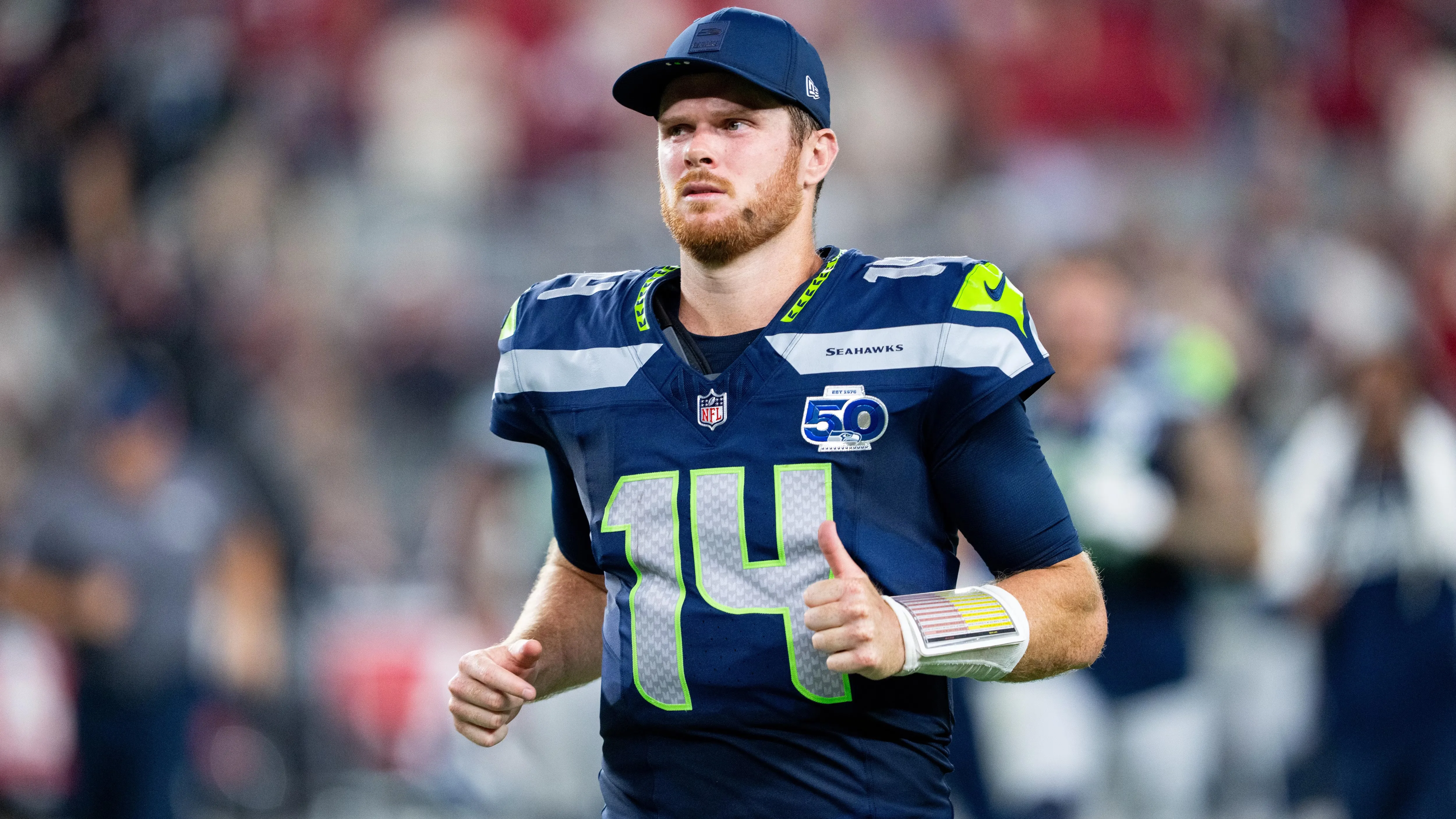
Minneapolis, Minnesota – January 8, 2026 – Sam Darnold, the star quarterback of the Seattle Seahawks in the NFL, has announced a profoundly humane gesture amid a national tragedy: he will donate $400,000 to the “Remembering Renee Nicole Good” fund – established to support the children of the victim shot dead by an ICE agent in Minneapolis just one day prior.
However, Darnold’s commitment goes beyond the money; he pledges to personally care for Renee’s 6-year-old son, the boy now left to live alone after losing both parents, shocking the entire United States and igniting a powerful wave of empathy.The incident has sparked nationwide outrage, with protests erupting and sharp criticism from politicians like Ilhan Omar and Alexandria Ocasio-Cortez. Good leaves behind three children: a 15-year-old daughter and 12-year-old son living with their biological father in Colorado, and a 6-year-old son from her second marriage to Timmy Ray Macklin Jr. – a former soldier who died in 2023 from PTSD.
With Renee’s death, the 6-year-old boy is now truly orphaned, with no one else in his life except his grandfather, Timmy Ray Macklin Sr., who is striving to gain custody.
The “Remembering Renee Nicole Good” fund, based on an initial GoFundMe campaign started by friends and the community, has quickly raised over $370,000 from the public.
The fund is dedicated specifically to supporting Renee’s children in surviving and thriving, including costs for education, healthcare, housing, and daily needs. “This is not just relief money; this is how we keep Renee’s legacy of love alive through her children,” shared Mattie Weiss, the fund’s organizer, in a statement.

Sam Darnold, 28 and one of the NFL’s top quarterbacks with a contract worth hundreds of millions of dollars, was deeply moved by the story of the 6-year-old boy. In a post on X (formerly Twitter) and an interview with ESPN,
Darnold stated: “I couldn’t sit idly by knowing a child is facing such loss. $400,000 is just the start; I commit to caring for the boy until he turns 18. That means supporting his education, mental health, and any needs for a bright future. I will also help his grandfather if they need it – perhaps with legal support, finances, or simply as a companion.”
Darnold’s commitment has spread rapidly, garnering thousands of shares and praise from NFL peers like Geno Smith (his predecessor at the Seahawks) and Kyler Murray. “Sam is not just an athlete; he’s a true human being,” Smith commented. This event has also sparked broader discussions about the impact of immigration policies on American families, especially orphaned children due to state violence.
The boy’s grandfather, Timmy Ray Macklin Sr., expressed gratitude: “Sam has brought hope to us in our darkest time. My grandson now has a ‘big brother’ from the NFL – that means the world to us.” The fund is currently coordinating with local organizations like Twin Cities DSA to ensure the money is used effectively, prioritizing Renee’s 6-year-old son.
With the 2025-2026 NFL season in full swing, Darnold’s action not only solidifies his image as a humanitarian icon but also encourages other sports stars to engage in social issues. If you wish to contribute, the “Remembering Renee Nicole Good” fund is still open on GoFundMe, aiming to reach $1 million for long-term support for the victim’s children.
Kansas City, Missouri — No rolled ankles. No torn ligaments. No screaming match with a coach. And yet something on the grass behind GEHA Field at Arrowhead Stadium felt completely off as the Kansas City Chiefs took the field for practice this morning.
The first sign wasn’t a blown assignment.
It was the silence.
George Karlaftis — the 24-year-old pass rusher who usually turns every rep into a war cry, the energy source of Steve Spagnuolo’s defense — walked out in full pads with his head down and his mouth shut. The same player who just signed a massive extension to be a cornerstone of this defense suddenly looked like a man carrying a weight no shoulder pads could hide.
Normally, Karlaftis is the one barking before the whistle, slamming helmets with teammates, demanding one more sprint when everyone else is spent. Today, he went through stretches on autopilot. No jokes. No smirks. No “let’s go” yell before the first team period. Even the younger guys — the ones who usually mirror his energy — slowed down, glancing his way between drills.
This wasn’t about his get-off. It wasn’t about his hands or footwork.
He was hurting somewhere no MRI can see.
And tucked inside the front pouch of his red practice hoodie wasn’t a laminated call sheet or a wristband of stunts and pressures.
It was a final message from someone who would never text him again.
The first 11-on-11 period had just started when it became obvious something was wrong. Karlaftis jumped offsides on a hard count he’s seen a thousand times. On the next snap, he lost contain on a basic outside zone. A few plays later, he froze instead of crashing down on a run fit he could normally execute in his sleep.
Spagnuolo blew the whistle and walked toward his defensive end — the same guy he’s praised for relentless motor and focus since his rookie year.
“You alright, George?” the coordinator asked quietly, away from cameras and the rest of the huddle.
Karlaftis nodded. His chinstrap was still buckled. But his eyes, just for a second, betrayed him.
Because this wasn’t just a bad day of practice.
It was his first day on an NFL field since the league learned that 24-year-old Dallas Cowboys defensive end Marshawn Kneeland had died of an apparent suicide in Frisco, Texas — after sending goodbye texts to his loved ones.
For most fans in Kansas City, Kneeland is a name on another team’s depth chart — a promising young defender who had just scored the first touchdown of his career on Monday Night Football. For Karlaftis, he was something else entirely.
They met in the pre-draft process and bonded fast — two defensive linemen chasing the same dream from different corners of the country, thrown into the same hotel ballrooms, meeting rooms, and practice fields. They stayed in touch through their rookie seasons, checking in after tough games, swapping clips, talking about pass-rush counters, homesickness, and the pressure of being “the next big thing” for their families.
When Kneeland lost his mother unexpectedly in 2024, Karlaftis was one of the people who kept calling. One of the people who knew that behind the sacks and celebrations was a son still trying to learn how to live without the person who had pushed him this far.
By the time this week came, Kneeland’s world had narrowed to a few pillars: his dad, his younger siblings, and the girlfriend who walked with him through every high and low. They were the ones he carried into every meeting, every lift, every snap.
The notification came at 1:13 a.m.
Karlaftis was at home in Kansas City, watching third-down tape, clicking from one cut-up to the next. When his phone buzzed, he glanced down, saw Kneeland’s name, and let it sit. He’d answer after this play. After this note. After this drive.
By the time he opened it, it wasn’t the start of a conversation.
It was a goodbye.
“I’m so tired, George. If I don’t make it… promise me you will. One of us has to finish the dream. Don’t let my dad and my little brothers be alone. And please look after my girl — you know she’ll act strong, but she’s going to need someone.”
Hours later, news alerts lit up phones across the NFL: Kneeland, 24, found dead in Frisco, Texas; authorities investigating an apparent self-inflicted gunshot wound after a police pursuit. Statements from the Cowboys. From the league. From his agent. From his college program at Western Michigan. Articles repeated the same lines — “apparent suicide,” “second-year defensive end,” “only 24.”
Karlaftis read every single one.
And then he still had to go to work.
So this morning, when he lined up in a simple 9-technique on the right edge, feeling the Missouri wind cut across the practice field, he wasn’t really seeing Patrick Mahomes in the huddle or the offensive line in front of him. All he could picture was a grieving father at a kitchen table, younger siblings staring at an empty chair, and a young woman holding a phone that would never light up with Marshawn’s name again.
A basic run fit turned into a busted edge. A stunt call got lost in the wash. Even when he did everything right, it felt wrong. His legs were on the grass in Kansas City. His heart was in Texas.
Eventually, practice slowed to a crawl. The usual crackle of trash talk and encouragement faded. Teammates could sense what Spagnuolo already knew: today wasn’t about correcting alignments or pad level.
The whistle blew. The defense huddled.
Still holding his helmet, eyes red but voice steady, Karlaftis spoke once.
“Today was the worst practice of my life — not because of the scheme or the offense… but because I had to practice without him. From now on, every rep is for Marshawn, for his dad, his little brothers, and for the girl he loved.”
No one mentioned pressures or sacks. No one talked about the Chiefs’ 5–4 start or their playoff odds. Chris Jones stepped forward and pulled him in. Nick Bolton and Leo Chenal flanked him, saying nothing — because sometimes the hits that hurt most never show up on film.
The Chiefs have given Karlaftis permission to step away and attend services when the time comes. When he returns — whether it’s for a walkthrough, a Wednesday install, or a primetime showdown at Arrowhead — there will be a strip of white tape wrapped around one of his wrists, with a single word written in black ink:
Not just a tribute to a teammate from another locker room.
A promise to the dream they built together — and to a father, a set of younger siblings, and a girlfriend Marshawn begged him not to leave alone.
People always ask what the hardest hit in football really is. Most imagine a free rusher off the edge, a blind-side shot that sends a quarterback sprawling, or a pile-up that leaves bodies slow to rise.
The cruelest blow doesn’t happen between whistles.
It happens at 1:13 a.m., on a phone screen, when a message turns a fellow player into the lone survivor of a promise — and hands him the weight of a grieving family he can’t possibly carry alone.
George Karlaftis will keep stepping onto the practice field. He’ll run through individual drills, team periods, two-minute simulations. To anyone watching from the sideline or scrolling clips on social media, it might all start to look normal again.
But from now on, every step out of his stance, every strike of his hands, every chase down the line will carry a weight the crowd can’t see — one that will never appear in a box score or PFF grade.
There are hits that knock you down for a few seconds.
And there is a kind of pain that leaves no bruise, draws no blood — but forces the one left standing to borrow the strength of the one who’s gone… just to keep lacing up his cleats, looking a broken family in the eye, and walking back into the huddle.