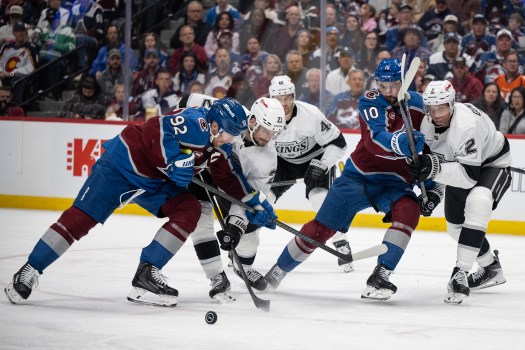
The Colorado Avalanche are set to face the Los Angeles Kings in Game 3 of their 2026 Stanley Cup Playoffs First Round on Thursday, April 23, 2026, at Crypto.com Arena in Los Angeles, California.
After splitting the first two games at home — winning Game 1 (2–1) and losing Game 2 (3–2) — the series is now tied 1–1, and Colorado heads into Game 3 looking to seize momentum on the road.
As Presidents’ Trophy winners and one of the league’s most‑feared postseason teams, the Avalanche are aiming to take control of this series with a pivotal win on Kings ice before returning home for Games 4 and 5.
Avalanche’s Top Line vs Kings’ Defense
Colorado’s offense — led by Nathan MacKinnon, Mikko Rantanen, and playmaker Sean Walker — will look to attack Los Angeles’ blue line early. MacKinnon’s elite transition speed and Rantanen’s relentless net‑front presence are central to Colorado’s strategy, especially in road games where momentum swings are magnified.
Avalanche Defense vs Kings’ Scoring Attack
Defensively, the Avalanche must contain Anže Kopitar and Adrian Kempe, two of the Kings’ most dangerous forwards. Colorado’s blueliners and goaltender Scott Wedgewood will need to limit odd‑man rushes and physical high‑slot chances to keep L.A.’s transition game in check.
Expect an intense, momentum‑driven matchup as both teams vie for control of this first‑round series. If Colorado can generate sustained pressure in the offensive zone and limit the Kings’ transition chances, they have a strong shot at stealing Game 3 on the road.
With elite offensive talent and strong goaltending, the Avs should be in this game until the final minutes.
The Los Angeles Rams moved quickly after their season-ending defeat, firing offensive coordinator Mike LaFleur in the immediate aftermath of their NFC Championship loss.
The Rams were eliminated by the Seattle Seahawks, who punched their ticket to Super Bowl LX with a dramatic win at Lumen Field in Seattle.
Seattle quarterback Sam Darnold delivered a near-flawless performance, throwing for 346 yards and three touchdowns without committing a turnover. His command of the offense consistently kept the Rams’ defense on its heels.
Matthew Stafford answered with a strong statistical night of his own, passing for 374 yards and three touchdowns. Still, the Rams failed to capitalize late, unable to complete a comeback in the final minutes.
Former Rams star Cooper Kupp played a decisive role against his old team, hauling in a critical fourth-quarter reception that allowed Seattle to maintain control of the game. Moments later, the Seahawks’ defense came up with a defining stop at the Rams’ six-yard line with under five minutes remaining.
While the loss was the breaking point, frustration with the Rams’ offensive system had been building throughout the 2025 season. Despite leading the NFL in total offense, Los Angeles repeatedly struggled to convert red-zone opportunities into touchdowns.
Slow starts also plagued the unit, with several high-profile games featuring early three-and-out possessions that put unnecessary pressure on the defense. These patterns resurfaced in the biggest game of the year.
Protection issues further complicated matters, as Stafford continued to face heavy pressure against blitz-heavy defenses. The offensive line showed flashes but lacked consistent stability against adaptable schemes.
Internally, concerns remained about LaFleur’s ability to manage games independently. With Sean McVay retaining primary play-calling duties, questions persisted about in-game adjustments when opponents shifted strategies.
Following his dismissal, LaFleur reportedly did not hide his anger over how the season ended.
“The Seahawks cheated and it cost me my job. They can celebrate now, but I’ll be back, with the San Francisco 49ers or the Arizona Cardinals, and I’ll make sure they pay for it twice a year.”
The Rams’ decision signals a broader reset on offense, prioritizing efficiency and execution over raw yardage. As Los Angeles enters a critical offseason, the pressure is now on to find an offensive leader who can deliver when the stakes are highest.